The Sweaty Atom
What a boiling atomic nucleus teaches us about hidden correlations and the illusion of independent events.

Imagine a single drop of water, heated to billions of degrees, floating in the absolute vacuum of space. It is violently unstable, rotating and churning with excess vibrations and heat. To avoid completely blowing itself apart, it has to cool down.
It has to sweat.
Video 1: Have a look at what happens to an excited ball of water on the space station.
When we smash atomic nuclei together in a particle accelerator, sometimes they fuse into a superheated microscopic drop of nuclear matter. We call this a compound nucleus. To shed its massive internal energy, the nucleus evaporates subatomic particles. But because this drop is unfathomably small and strongly bound, it plays by the rules of quantum mechanics. The “sweat” doesn’t just casually boil off the surface—the particles have to quantum-tunnel their way out of the nucleus’s energetic cage.
Usually, one can assume that a nucleus takes the path of least resistance, sweating out a single proton or neutron, depending on which of the two it has more to spare.
But my colleagues and I wanted to catch it doing something much rarer: sweating a deuteron.
A deuteron is an isotope of hydrogen: a proton and a neutron holding hands. Statistically, emitting a deuteron is a long shot. The two particles don’t hold hands very strongly. Inside the chaotic, boiling violence of a superheated nucleus, it is incredibly rare for them to hit the quantum barrier at the exact same time and escape together.
But under the right conditions, the laws of thermodynamics flip the odds. And if you want to understand how complex systems actually work, you have to look at what happens when the energy budget gets tight.
Simulating the Quantum Casino
You can’t just stick a thermometer into a boiling atom to see what happens. You have to build a tool to map out the exact probability of every possible escape route.
To do this, we used the Weisskopf evaporation model: a statistical framework initially from the 1930s that basically calculates the phase space, or the “casino odds,” of particle emission.
The math here is quite involved. I developed most of it while I was visiting my sister at her office in Amsterdam. Her office is blessed with beautiful views over the canals. Basically, if you have many possible ways of releasing this energy, as many as the Amsterdam canals (in fact, they are called channels), and you have to follow all of them it’s much easier if you build a map first. Once you’ve looked at all the water there’s in Amsterdam, you can focus on what happens if you drop a bucket of paint in the Amstel. So, thank you sis.
To tame the algebraic chaos and build this map of nuclear channels, I used Mathematica (As a quick aside: the tech world is currently losing its mind over LLMs occasionally helping with calculations, while physicists have quietly been using Mathematica to execute flawlessly complex symbolic algebra for decades).
Once I derived the equations into a manageable form, one compact for writing and one efficient for programming, I built a Monte Carlo simulation. Monte Carlo simply means rolling the dice over and over again until you explore all possible configurations of the statistical process and establish their relative properties. In this way, we simulated millions of nuclear decay chains to see exactly how the probability of a deuteron evaporating stacked up against any other, and in particular a proton.
Catching the Ghost
First, we actually caught the ghost. For the first time, the experimental setup developed in Lund by Yuliia Hrabar (now at Berkeley labs) and Pavel Golubev (now at ESS) unequivocally detected and identified evaporated deuterons.
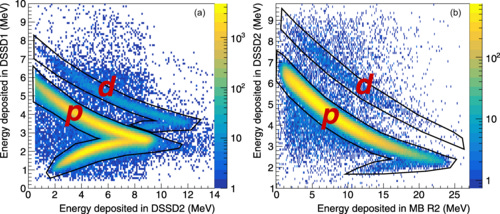
Fig 1. The experimental proof. By tracking particle energy and trajectory, we successfully separated the elusive deuterons (d) from standard protons (p).
The discovery is why and when this happens.
Every time a nucleus ejects a particle, it pays an “energy tax” to the particle flying away, tunneling through the Coulomb barrier in the case of charged particles. In this way, emitting a single proton cools down the nucleus by several energy units (MeV)1. But, despite the rarity of finding in the conditions to do so, emitting a deuteron comes with a loophole. Because the proton and neutron are physically bound together, their escape comes with an extra 2.2 MeV of binding energy. This provides an extra push, a “coupon” to the tax.
If the nucleus is extremely hot and flush with energy, it ignores the coupon. It just violently boils off independent protons.
But as the nucleus cools down and its energy budget shrinks, it can literally no longer afford the tax of emitting separate particles. Suddenly, emitting a deuteron isn’t just a rare statistical anomaly but becomes favoured and more probable than others. In some cases, because of that extra binding energy, it is the only emission allowed.
Even though the process is still clearly statistical (even more so than usual, because it follows quantum mechanics), it is still possible to predict its features. For example, the extra energy provided by the deuteron clearly biases the process, leaving the residual nucleus in a higher excited state with a higher probability.
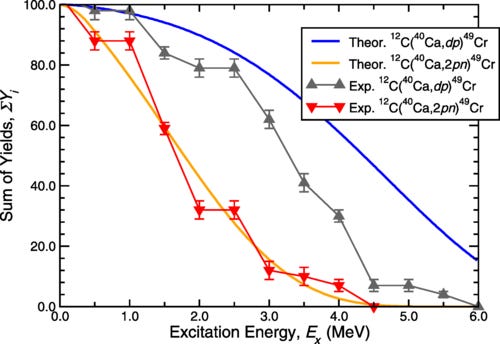
Fig 2. The theoretical model (blue and orange lines) compared to the experimental data (triangles, joined by lines). You can see how the extra binding energy of the deuteron (gray) alters the trajectory, populating states in the remaining nucleus at higher excitation energy compared to standard proton-neutron emission.
The secret hope of the experiment, of course, was to find a massive, glaring deviation from my theoretical model. Mostly, for the timeless joy of experimentalists proving a smug theoretician wrong… but honestly, I was rooting for them to break it! That’s because my model has one deliberate blind spot: it assumes the probability of a proton and neutron holding hands inside the nucleus is just standard statistical luck. But some hints suggest otherwise. If a nucleus has a specific symmetry, the exact same number of protons and neutrons, leaving just one lonely pair floating outside a tightly packed core, they should be more willing to pair up than in other cases, especially those where each proton can find another proton as companion (or similarly for neutrons with neutrons). We call this pairing of protons and neutrons… proton-neutron pairing (yes, I know…). It’s one of the great open puzzles in nuclear physics. We didn’t catch it this time and the model held up, so the game is still afoot.
The Takeaway
In both science and life, we constantly deal with complex, probabilistic systems.
When observing these systems, it is tempting and convenient to assume that events happen independently. This is done in most cases. Even in many massive models, like the ones used to design and run nuclear reactors, particle evaporation are treated as a relatively generic, independent event from the gamma decays.
However, they clearly aren’t independent. Our research shows an undeniable correlation between what specific particle is emitted and the internal state the nucleus is left in. A tiny internal constraint, like a proton and neutron weakly holding hands, can fundamentally alter the macroscopic outcome of the system.
When your model ignores the hidden correlations between micro-events, your picture of reality is incomplete, and your “digital twin” lacks fundamental realism. Whether you are modelling a chain reaction in a nuclear reactor or risk in a financial portfolio, assuming variables are independent when they are actually correlated is exactly how models blow up.
True understanding comes from looking at the sweat.
If you want to know more, Deuteron evaporation from 𝑁=𝑍 compound nuclei
An MeV corresponds to the energy a proton would get by passing through a million Volts of electric potential, much higher than the 220V of your wall outlet or the 100 thousand Volts of typical high-tension overhead lines.